Research activities
-
Cavitation modelling for steady and unsteady flow in pumps
-
Experimental andCFD comparison
-
Numerical optimization of impeller for very low NPSH
Projects
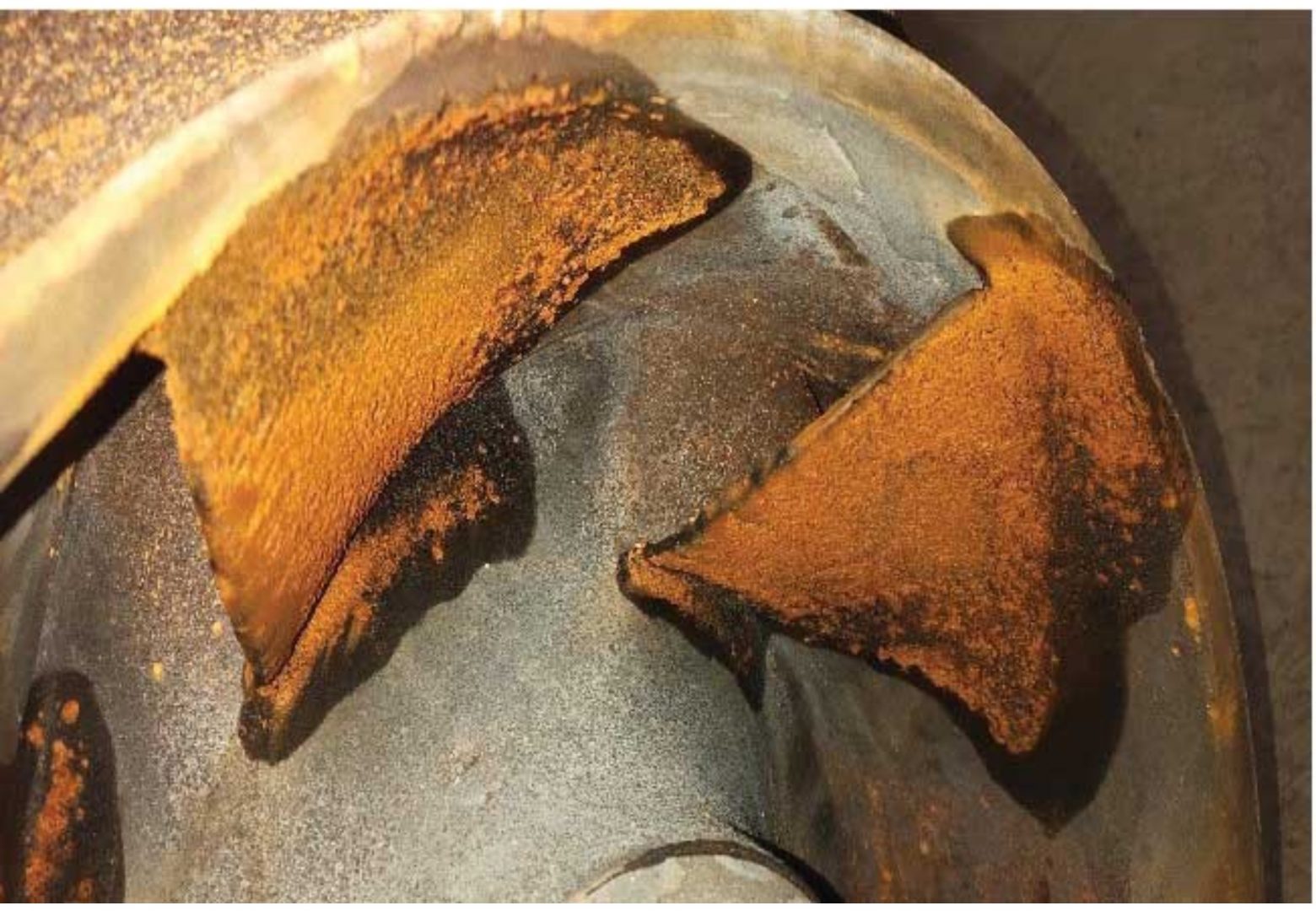
Cavitation in hydraulic machines is an important phenomenon to consider for performance prediction. Optimization of the impeller geometry requires a correct analysis of the occurrence of cavitation and an understanding of the flow structure and kinetic mechanism of cavitation instability and the effects on the flow field as the pressure level decreases.
Based on the visualization of the flow and identification of the cavitation morphology under different operating conditions, the evolution laws and three-dimensional structure of the cavitation flow field are defined on the basis of geometric and functional parameters.
The identification of the control factors influencing the diffusion and cavitation state will make it possible to define a method for optimizing the hydraulic model of key components such as the impeller and guide vane, and to promote the localization process of submersible pumps also for liquids other than water, such as LNG, and with different percentages of air in the liquid.
The results will be compared with the experimental data.
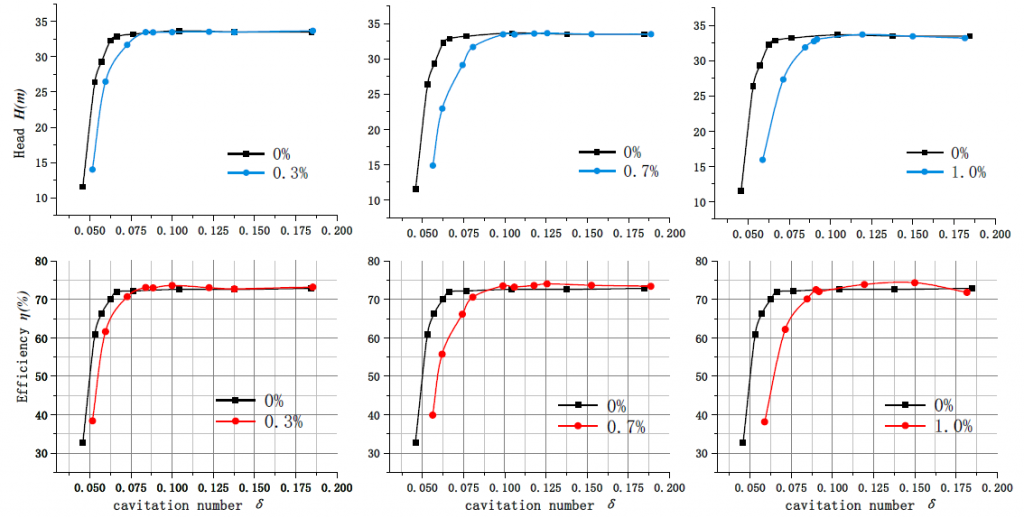
Comparison of performance curve with various content of entrained airTools
Facility – Pump Facility
Mesh Tools – ICEM
CFD Tools – ANSYS CFX
Post Processing Tools – Matlab and Python
Publications
2025
Yin, Tingyun; Pavesi, Giorgio
Compressibility characteristics of transient sheet/cloud cavitation – a numerical survey Journal Article
In: International Communications in Heat and Mass Transfer, vol. 162, 2025, ISSN: 07351933.
Abstract | Links | BibTeX | Tags: Cavitation, Condensation shock, Energy conversion, Shock wave
@article{Yin2025d,
title = {Compressibility characteristics of transient sheet/cloud cavitation – a numerical survey},
author = {Tingyun Yin and Giorgio Pavesi},
doi = {10.1016/j.icheatmasstransfer.2024.108560},
issn = {07351933},
year = {2025},
date = {2025-01-01},
urldate = {2025-01-01},
journal = {International Communications in Heat and Mass Transfer},
volume = {162},
publisher = {Elsevier Ltd},
abstract = {In this study, the transient compressible sheet/cloud cavitation around the stationary blade is investigated using a Computational Fluid Dynamics (CFD) method. The instantaneous characteristics of the cavity, such as the destabilization of the sheet cavity, the transformation of the sheet topology into the cloud topology, and the process of shrinking and collapsing of the cloud cavity, are reasonably replicated. The examination of the sheet cavity reveals that the disturbance moving upwards within the cavity is a condensation shock. This shock adheres to the classical Rankine–Hugoniot jump conditions and travels at a hypersonic speed. Once the condensation shock reaches the point where the cavity separates, the sheet cavity unlocks from the surface and transitions into a cloud cavity. The cloud cavity undergoes a reduction in size as it is carried downstream and collapses in the zone of high pressure. Investigations of a small cloud cavity reveal that its collapse results in the release of immense pressure, reaching several million Pascals. Furthermore, the relationship among potential energy, kinetic energy, and pressure wave energy during the collapse of the cavity is exposed, contributing to a more comprehensive comprehension of this intricate phenomenon.},
keywords = {Cavitation, Condensation shock, Energy conversion, Shock wave},
pubstate = {published},
tppubtype = {article}
}
Yin, Tingyun; Pavesi, Giorgio
Interpreting proper orthogonal decomposition modes extracted from partial cavity oscillation Journal Article
In: Physics of Fluids, vol. 37, iss. 1, 2025, ISSN: 10897666.
Abstract | Links | BibTeX | Tags: Cavitation, Cavity, Orthogonal Decomposition
@article{Yin2025c,
title = {Interpreting proper orthogonal decomposition modes extracted from partial cavity oscillation},
author = {Tingyun Yin and Giorgio Pavesi},
doi = {10.1063/5.0244165},
issn = {10897666},
year = {2025},
date = {2025-01-01},
urldate = {2025-01-01},
journal = {Physics of Fluids},
volume = {37},
issue = {1},
publisher = {American Institute of Physics},
abstract = {This study employs the two-dimensional proper orthogonal decomposition approach to analyze the pressure, vapor fraction, and streamwise velocity flowfields of partial cavity oscillation. The interrelations among mode, energy ratio, temporal coefficient, and flowfield reconstruction are thoroughly examined, thereby augmenting comprehension of the cavitating flow mechanism and bubble dynamics. It is found that the first modes of the pressure, vapor fraction, and streamwise velocity flowfields contain 56.31%, 36.37%, and 31.81% energy, respectively; the decrease in energy ratio results in the variation of its temporal coefficient close to sinusoidal configurations. Moreover, the temporal coefficient of the first mode varies closely related to the flowfield-relevant variable. The first modes of the pressure, vapor fraction, and streamwise velocity flowfields are significantly different, but all have two highlighted structures closely related to the self-variable system. The strong nonlinearity and high dimensionality of the cavitation flowfield render precise reconstruction using a limited number of modes exceedingly challenging. The data approximate the original snapshot more closely when the flow field is reconstructed with a greater number of modes. Although the location with a relatively high root mean square reconstruction error is significantly different when the first nine modes are used for flowfield reconstruction, its order of magnitude is less than the self-variable system, and the order discrepancy is fixed, equal to 1.},
key = {Cavitation, Orthogonal decomposition, Cavity},
keywords = {Cavitation, Cavity, Orthogonal Decomposition},
pubstate = {published},
tppubtype = {article}
}
Shen, Jiantao; Jia, Xuanwen; Cheng, Li; Jiao, Weixuan; Zhang, Bowen; Pavesi, Giorgio
Investigation into the coupling mechanism of tailwater vortex dynamics and cavitation during pump-as-turbine operations Journal Article
In: Physics of Fluids, vol. 37, iss. 10, 2025, ISSN: 10897666.
Abstract | Links | BibTeX | Tags: Cavitation, PAT, Pump as turbine
@article{Shen2025b,
title = {Investigation into the coupling mechanism of tailwater vortex dynamics and cavitation during pump-as-turbine operations},
author = {Jiantao Shen and Xuanwen Jia and Li Cheng and Weixuan Jiao and Bowen Zhang and Giorgio Pavesi},
doi = {10.1063/5.0287323},
issn = {10897666},
year = {2025},
date = {2025-01-01},
urldate = {2025-01-01},
journal = {Physics of Fluids},
volume = {37},
issue = {10},
publisher = {American Institute of Physics},
abstract = {In order to investigate the coupling mechanism between tailwater vortex and cavitation bubbles (CB) during the operation of a low-head pump-as-turbine (PAT), the method of combining experiment and numerical simulation is used to quantify the vortex dynamics characteristics in combination with the vorticity transport equation under high flow conditions for PAT mode. The results show that the decrease in Thoma number significantly regulates the symbiotic evolution of tailwater vortex and CB: prolonging the residence time of CB in the draft tube (DT) and changing its evolution mode, resulting in the extension of vortex rope (VR) generation period, length contraction, and the increase in breaking vortex in DT. The peak volume of CB is 7 times that in the rotor region, squeezing the channel vortex and the wake vortex, weakening its contribution to VR. Vortex dynamics shows that the relative vortex stretching term is the core driving force of vorticity, which causes velocity gradient distortion and VR high-frequency oscillation synchronously with vertical vorticity. The baroclinic torque term (BT) only generates pulse contribution in the early stage of CB collapse. Under critical cavitation, BT converts the cavity collapse energy into vortex energy through density-pressure gradient coupling, which expands the vortex core radius to 0.03 m, increases the circulation peak to 2.3 m2/s, and shifts outward by 27.3%, resulting in vortex energy diffusion and high-frequency oscillation of the flow field. This study provides a theoretical basis for cavitation suppression and operational optimization of low-head PAT.},
key = {Cavitation, PAT, Pump as Turbine, tailwater vortex},
keywords = {Cavitation, PAT, Pump as turbine},
pubstate = {published},
tppubtype = {article}
}
Yin, Tingyun; Pavesi, Giorgio
Several compressible computational fluid dynamics methods applied to transient sheet/cloud cavitation Journal Article
In: Physics of Fluids, vol. 37, iss. 2, 2025, ISSN: 10897666.
Abstract | Links | BibTeX | Tags: Cavitation, Cloud cavitation, Sheet cavitation
@article{Yin2025b,
title = {Several compressible computational fluid dynamics methods applied to transient sheet/cloud cavitation},
author = {Tingyun Yin and Giorgio Pavesi},
doi = {10.1063/5.0252333},
issn = {10897666},
year = {2025},
date = {2025-01-01},
urldate = {2025-01-01},
journal = {Physics of Fluids},
volume = {37},
issue = {2},
publisher = {American Institute of Physics},
abstract = {This paper introduces several compressible computational fluid dynamics (CFD) methods and assesses their ability to simulate typical sheet-to-cloud cavitating flow around a hydrofoil. More precisely, the Tait equation of state is used to describe the density of water, while the ideal gas equation of state is used to model the density of vapor. The first method assumes that the cavitation is a multiphase flow with isothermal conditions, meaning that it exhibits isothermal compressibility. Based on the first method, the second and third methods take into account the thermal energy and total energy equations, respectively, i.e., the thermal energy compressibility and the total energy compressibility. An incompressible simulation is also performed for the comparison. The results show that all of the strategies successfully replicate the periodic breakup of the sheet cavity and the formation of the cloud cavity. The predicted frequency of cavity shedding using compressible methods is higher than that using the incompressible method. In addition, all the CFD simulations confirm that the disturbance moving upward in the sheet cavity is actually a condensation shock. The overpressure resulting from the collapse of the cavity can be captured using three compressible approaches. The boundary layer and time-averaged hydrofoil pressure coefficient are compared and analyzed, revealing a negligible difference among the three compressible simulation results.},
key = {Cavitation, sheet cloud},
keywords = {Cavitation, Cloud cavitation, Sheet cavitation},
pubstate = {published},
tppubtype = {article}
}
Yin, Tingyun; Pavesi, Giorgio
Study of sheet cavitation on a pitching hydrofoil Proceedings Article
In: Journal of Physics: Conference Series, Institute of Physics, 2025, ISSN: 17426596.
Abstract | Links | BibTeX | Tags: Cavitation, Pitching hydrofoil, Sheet cavitation
@inproceedings{Yin2025,
title = {Study of sheet cavitation on a pitching hydrofoil},
author = {Tingyun Yin and Giorgio Pavesi},
doi = {10.1088/1742-6596/3143/1/012125},
issn = {17426596},
year = {2025},
date = {2025-01-01},
urldate = {2025-01-01},
booktitle = {Journal of Physics: Conference Series},
volume = {3143},
issue = {1},
publisher = {Institute of Physics},
abstract = {The dynamic cavitation on a moving wall is garnering increasing interest because many fluid machinery systems operate under dynamic conditions in real-world scenarios. This study adopts a numerical method to investigate sheet cavitation on a pitching hydrofoil with the objective of elucidating the dynamic behaviour of the cavity and its influence on hydraulic performance. The results show that dynamics of the sheet cavity on the up-pitching hydrofoil exhibit significant delay effects. Within the downstroke phase from the maximum to the mean angle of attack, the features of the sheet cavity on the pitching hydrofoil are close to those on the stationary hydrofoil. However, the swift pitching action of the hydrofoil can result in a rapid fluctuation in the second derivative of the cavity area. The hydrofoil consistently experiences a significant reduction in lift and an increase in drag.},
keywords = {Cavitation, Pitching hydrofoil, Sheet cavitation},
pubstate = {published},
tppubtype = {inproceedings}
}
2023
Yin, Tingyun; Pavesi, Giorgio; Yuan, Shouqi
Influenced of Bio-Inspired Leading-Edge Tubercle on Cloud Cavitation Around NACA 0009 Hydrofoil Proceedings Article
In: ETC, (Ed.): Proceedings of 15th European Conference on Turbomachinery Fluid dynamics & Thermodynamics ETC15, April 24-28 2023; Budapest, Hungary, pp. 1-14, ETC, 2023.
Abstract | Links | BibTeX | Tags: Bio-Inspired, Cavitation, Hydrofoil, Tubercle
@inproceedings{YinPav2023-02,
title = {Influenced of Bio-Inspired Leading-Edge Tubercle on Cloud Cavitation Around NACA 0009 Hydrofoil},
author = {Tingyun Yin and Giorgio Pavesi and Shouqi Yuan},
editor = {ETC},
url = {https://research.dii.unipd.it/tes/},
year = {2023},
date = {2023-01-01},
urldate = {2023-01-01},
booktitle = {Proceedings of 15th European Conference on Turbomachinery Fluid dynamics & Thermodynamics ETC15, April 24-28 2023; Budapest, Hungary},
pages = {1-14},
publisher = {ETC},
abstract = {The current work numerically investigated the cloud cavitation around the hydrofoil with leading-edge tubercles, aiming to determine the dynamic characteristics of the bubble cluster and induced vortices. Also, comparisons between the baseline and modified hydrofoils were made to determine the influence of leading-edge tubercles on the partial cavity oscillation. The results show that the lift-to-drag ratio of the bionic hydrofoil is improved by 6.60% though the force coefficients are reduced. The instability mechanisms associated with cloud cavitation around two hydrofoils are different. Specifically, the re-entrant jet and a pair of streamwise vorticity are the reasons for the bubble instability around the baseline and bionic hydrofoils, respectively. Although the bionic hydrofoil is symmetry, both bubbles and vortices distribute in an asymmetry manner. Therefore, the proper orthogonal decomposition modes of the pressure field around two hydrofoils are different but closely coherent with the development of vortices.},
keywords = {Bio-Inspired, Cavitation, Hydrofoil, Tubercle},
pubstate = {published},
tppubtype = {inproceedings}
}
2019
Yin, Tingyun; Pavesi, Giorgio; Pei, Ji; Yuan, Shouqi; Daniel, Nana Adu
Comparison of Various Turbulence Models Applied to a Twisted Hydrofoil Journal Article
In: Proceedings of the 10th International Symposium on Cavitation (CAV2018), iss. 5, pp. 269-275, 2019.
Abstract | Links | BibTeX | Tags: Cavitation, turbulence model, twisted hydrofoil, unsteady shedding
@article{Yin2019,
title = {Comparison of Various Turbulence Models Applied to a Twisted Hydrofoil},
author = {Tingyun Yin and Giorgio Pavesi and Ji Pei and Shouqi Yuan and Nana Adu Daniel},
doi = {10.1115/1.861851_ch52},
year = {2019},
date = {2019-01-01},
journal = {Proceedings of the 10th International Symposium on Cavitation (CAV2018)},
issue = {5},
pages = {269-275},
abstract = {Comparison of various turbulence models applied to a twisted hydrofoil 1,2Tingyun Yin; 2Giorgio Pavesi, 1Ji Pei*, 1Shouqi Yuan, 1Nana Adu Daniel 1National Research Center of Pumps, Jiangsu University, Zhenjiang 212013, China; 2Department of Industrial Engineering, University of Padova, Padova 35131, Italy Abstract In the paper, various turbulence models are compared and different modifications employed to investigate more in deep to what extent the RANS are applicable to simulate the unsteady cavitating flow around a twisted foil. The predicted vapor shedding frequency and lift force coefficient are compared with the experimental data. Moreover, the dynamics behavior induced by the cavitation is discussed in detail. The results show that frequency predicted by density correction based model (DCM) SST is much closer to the experimental data, but the model fails to predict the second shedding vapor. In general, DCM RNG shows a better prediction ability. Firstly, a vapor cloud is sheared toward downstream due to the effect of main flow and re-entrant flow. After that, the second shedding vapor catches up with the first one and becomes the main vapor. The oscillation of the lift coefficient changes consistently with the vapor fluctuations and when a second vapor shedding is highlighted, a second peak value occurs in the time history of lift coefficient.},
keywords = {Cavitation, turbulence model, twisted hydrofoil, unsteady shedding},
pubstate = {published},
tppubtype = {article}
}
2015
Cavazzini, Giovanna; Pavesi, Giorgio; Santolin, Alberto; Ardizzon, Guido; Lorenzi, Renzo
Using splitter blades to improve suction performance of centrifugal impeller pumps Journal Article
In: Institution of Mechanical Engineering, vol. 3, iss. 229, pp. 309-323, 2015, ISSN: 0957-6509.
Abstract | Links | BibTeX | Tags: accepted, Cavitation, centrifugal pumps, date received, plesset cavitation model, rayleigh, Rayleigh-Plesset, splitter blades, suction performance
@article{Cavazzini2015,
title = {Using splitter blades to improve suction performance of centrifugal impeller pumps},
author = {Giovanna Cavazzini and Giorgio Pavesi and Alberto Santolin and Guido Ardizzon and Renzo Lorenzi},
url = {http://pia.sagepub.com/lookup/doi/10.1177/0957650914563364 http://journals.sagepub.com/doi/10.1177/0957650914563364 http://journals.sagepub.com/doi/abs/10.1177/0957650914563364},
doi = {10.1177/0957650914563364},
issn = {0957-6509},
year = {2015},
date = {2015-01-01},
urldate = {2015-01-01},
journal = {Institution of Mechanical Engineering},
volume = {3},
issue = {229},
pages = {309-323},
publisher = {journals.sagepub.com},
abstract = {A comparison between centrifugal impeller pumps with and without splitter blades in terms of suction performance is presented by experimental tests and numerical analyses. The design of both pumps was carried out by preserving the impeller meridional shape, number of blades, and volute casing. Blade shapes were obtained by adopting a 1D inverse design method. The same blade loading distribution was assumed for the full blades of both impellers, while the loading distribution of the splitter blades was modified until a close matching between the two head-capacity curves was achieved. The fulfilment of this performance requirement and the use of the same number of blades were needed to describe accurately the role played by the splitter blades in cavitation inception and development. Differently from other experimental comparisons, where previous requirements were not met, a noticeable improvement in suction performance was found at large flow rates but not at partial ones, where a small deterioration in suction performance was observed. The crucial role played by the blade thickness blockage on the incidence flow angle at the leading edge of the full blades was also investigated.},
keywords = {accepted, Cavitation, centrifugal pumps, date received, plesset cavitation model, rayleigh, Rayleigh-Plesset, splitter blades, suction performance},
pubstate = {published},
tppubtype = {article}
}
2014
Rossetti, Antonio; Pavesi, Giorgio; Ardizzon, Guido; Santolin, Alberto
Numerical Analyses of Cavitating Flow in a Pelton Turbine Journal Article
In: Journal of Fluids Engineering, vol. 136, iss. 8, pp. 081304, 2014, ISSN: 0098-2202.
Abstract | Links | BibTeX | Tags: Cavitation, CFD, multiphase flow, pelton
@article{pop00014,
title = {Numerical Analyses of Cavitating Flow in a Pelton Turbine},
author = {Antonio Rossetti and Giorgio Pavesi and Guido Ardizzon and Alberto Santolin},
url = {http://fluidsengineering.asmedigitalcollection.asme.org/article.aspx?doi=10.1115/1.4027139 http://biomechanical.asmedigitalcollection.asme.org/article.aspx?articleid=1846558},
doi = {10.1115/1.4027139},
issn = {0098-2202},
year = {2014},
date = {2014-01-01},
urldate = {2014-01-01},
journal = {Journal of Fluids Engineering},
volume = {136},
issue = {8},
pages = {081304},
publisher = {… .asmedigitalcollection.asme.org},
abstract = {Erosion and wear of hydraulic surfaces are frequent problems in hydraulic turbines, which lead to a decrease of the performance in time and/or in extreme cases to the rotor mechanical failure. These circumstances have negative repercussions on the annual produced power due to the decay of the efficiency, the delivered power, and to the off line periods as result of ordinary and extraordinary hydraulic profiles maintenances. Consistently, the study of this wearing process is an important step to improve the impeller design, and to avoid or minimize the rise of extraordinary maintenance. While mechanical damages are well documented and studied, little information can be found on cavitation in Pelton turbines. In this paper, a CFD model was applied to study the cavitation mechanics on a Pelton turbine. A Pelton runner affected by pitting cavitation was taken as a test case. The bucket geometry was modeled and analyzed using unsteady Reynolds averaged Navier-Stokes (RANS) multiphase analyses. Numerical results allowed us to highlight the different vapor productions during the cut-in water jet processes by the bucket. Furthermore, a simple procedure to identify the locations of higher damage risk was presented and verified in the test case runner.},
keywords = {Cavitation, CFD, multiphase flow, pelton},
pubstate = {published},
tppubtype = {article}
}
2013
Pavesi, Giorgio; Rossetti, Antonio; Santolin, Alberto; Ardizzon, Guido
Numerical Analyses of a Cavitating Pelton Turbine Proceedings Article
In: 10th European Conference on Turbomachinery Fluid Dynamics and Thermodynamics, ETC 2013, pp. 1-12, 2013, ISSN: 24104833.
Abstract | BibTeX | Tags: Cavitation, CFD, Pelton turbine
@inproceedings{Pavesi2013,
title = {Numerical Analyses of a Cavitating Pelton Turbine},
author = {Giorgio Pavesi and Antonio Rossetti and Alberto Santolin and Guido Ardizzon},
issn = {24104833},
year = {2013},
date = {2013-01-01},
urldate = {2013-01-01},
booktitle = {10th European Conference on Turbomachinery Fluid Dynamics and Thermodynamics, ETC 2013},
pages = {1-12},
abstract = {Erosive wear of hydro turbine runners is a complex phenomenon, which depends upon many parameters and which leads to a decrease of the performance in time and/or in extreme cases to the rotor mechanical failure. Consistently, the study of this wearing process is an important step to improve the impeller design, to avoid or minimize the rise of extraordinary maintenance. In the present paper the cavitation mechanics of a Pelton turbine was investigated using CFD analyses. A Pelton affected by pitting cavitation was taken as test case. The Pelton geometry was modelled and analyzed using unsteady Reynolds averaged Navier-Stokes (RANS) multiphase analyses. The homogeneous approach was used to describe the multiphase flow composed by water, water vapour and air. Numerical results discriminated the vapour production processes during the cut in of the bucket on the water jet. The design and the part load flow rates were analyzed and the cavitation process compared. A simple procedure to identify the locations of higher damage risk was presented and verified on the test case runner.},
keywords = {Cavitation, CFD, Pelton turbine},
pubstate = {published},
tppubtype = {inproceedings}
}
1994
Ardizzon, Guido; Pavesi, Giorgio
Caratterizzazione Sperimentale del Comportamento a Cavitazione delle Pompe Centrifughe: Confronto fra Metodologie Convenzionali e Tecniche di Analisi Acustica Proceedings Article
In: 49° Congresso Nazionale ATI, pp. 1559-1570, SGE - Padova, 1994.
Abstract | BibTeX | Tags: Acustic Cavitation, Cavitation, Pump
@inproceedings{Ardizzon1994b,
title = {Caratterizzazione Sperimentale del Comportamento a Cavitazione delle Pompe Centrifughe: Confronto fra Metodologie Convenzionali e Tecniche di Analisi Acustica},
author = {Guido Ardizzon and Giorgio Pavesi},
year = {1994},
date = {1994-01-01},
urldate = {1994-01-01},
booktitle = {49° Congresso Nazionale ATI},
pages = {1559-1570},
publisher = {SGE - Padova},
abstract = {Vengono presentati i risultati di una ricerca sperimentale volta a caratterizzare il comportamento in regime di cavitazione di due pompe centrifughe. L'insorgere e l'evolvere della cavitazione sono analizzati mediante lo studio degli spettri del rumore prodotto dall'implosione delle bolle. I valori dell'NPSH di innesco e quelli corrispondenti a prefissate cadute della prevalenza sono tra loro confrontati e i diversi andamenti esaminati sulla base della geometria del bordo di ingresso delle pale e delle condizioni di deflusso.},
keywords = {Acustic Cavitation, Cavitation, Pump},
pubstate = {published},
tppubtype = {inproceedings}
}
1993
Pavesi, Giorgio; Ardizzon, Guido
Sulla Progettazione delle Turbopompe Centrifughe nei Riguardi della Cavitazione Proceedings Article
In: Congresso Nazionale "Macchine e Apparecchiature Idrauliche", pp. 543-562, 1993.
Abstract | BibTeX | Tags: Cavitation, Pump, Pump Design
@inproceedings{Pavesi1993,
title = {Sulla Progettazione delle Turbopompe Centrifughe nei Riguardi della Cavitazione},
author = {Giorgio Pavesi and Guido Ardizzon},
year = {1993},
date = {1993-01-01},
urldate = {1993-01-01},
booktitle = {Congresso Nazionale "Macchine e Apparecchiature Idrauliche"},
pages = {543-562},
abstract = {Viene presentato un procedimento per l'ottimizzazione del comportamento delle turbopompe centrifughe nei riguardi della cavitazione incipiente. Allo scopo è debitamente valutato il contributo e la mutua influenza dei singoli parametri che condizionano il fenomeno. Sono, quindi, proposte delle relazioni che consentono un9agevole previsione dell9NPSH e. un9adeguata verifica delle scelte di progetto.},
keywords = {Cavitation, Pump, Pump Design},
pubstate = {published},
tppubtype = {inproceedings}
}
1992
Ardizzon, Guido; Pavesi, Giorgio
Experimental study on cavitation in centrifugal pump impellers Journal Article
In: 47. ATI national congress, vol. II, pp. 847 - 856, 1992, (Query date: 2017-05-06).
Abstract | Links | BibTeX | Tags: Cavitation, Pump
@article{pop00059,
title = {Experimental study on cavitation in centrifugal pump impellers},
author = {Guido Ardizzon and Giorgio Pavesi},
url = {https://inis.iaea.org/search/search.aspx?orig_q=RN:25066942},
year = {1992},
date = {1992-01-01},
urldate = {1992-01-01},
journal = {47. ATI national congress},
volume = {II},
pages = {847 - 856},
publisher = {inis.iaea.org},
abstract = {Investigations concerning cavitation in centrifugal impellers were carried out in a closed circuit. The value of net positive suction head (NPSH) at different head drops and at breakdown have been used to verify the affinity laws. SIMBOLOGIA},
note = {Query date: 2017-05-06},
keywords = {Cavitation, Pump},
pubstate = {published},
tppubtype = {article}
}
Contacts


Prof. Giorgio Pavesi
Head of the TES Laboratories
+39-049-827-6768


Eng. Fanjie Deng