

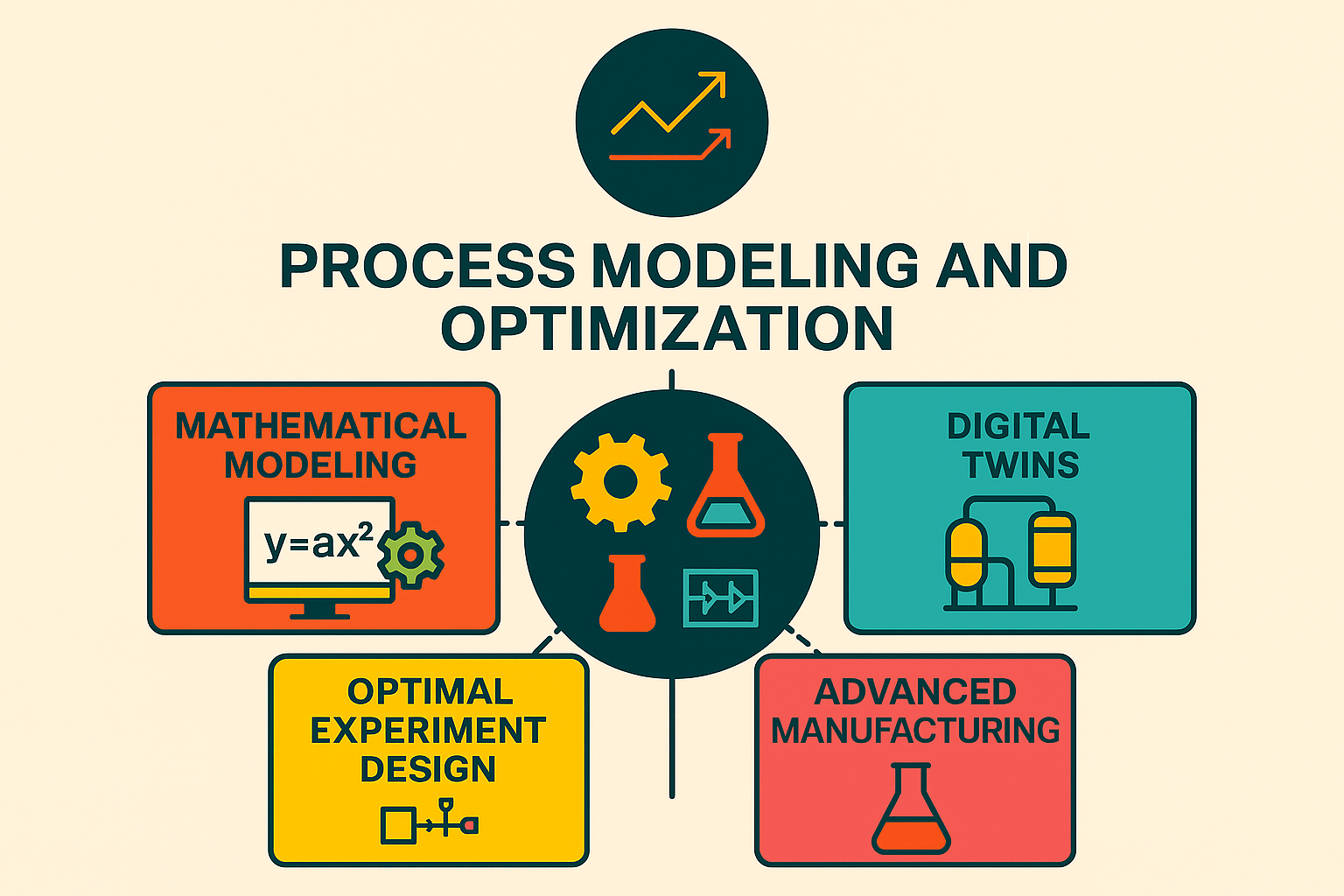
A deep understanding of any physical system can be captured and summarized through a mathematical model — a powerful tool that enables both simulation and optimization of system behavior. To ensure that such models accurately represent reality, controlled experiments must be conducted to investigate and validate their performance. The reliability of a model depends critically on two factors: the choice of an appropriate model structure and the accurate estimation of its parameters.
However, model development can become a highly complex and resource-intensive task when experiments are not planned with a solid scientific rationale. To address this, CAPE-Lab has developed specialized optimal experiment design techniques that maximize the information extracted from experimental data while minimizing the time and cost required for experimentation.
These optimal design methods (model-based design of experiments) have been successfully applied across a broad range of fields in process and biomedical engineering. Applications include:
- Pharmacokinetic and pharmacodynamic modeling to support drug development
- Physiological models for managing complex conditions such as diabetes, cancer, and coagulation disorders
- Process modeling and optimization for advanced manufacturing systems
- Development of digital twins
By combining rigorous statistical design with domain expertise, CAPE-Lab research integrates first-principles, data-driven, and hybrid modeling approaches, also with the support of artificial intelligence, to deliver more reliable models, faster development cycles, and greater confidence in simulation, prediction, optimization, and control strategies.
